
I went to an interesting talk the other day and thought I would share some of the learnings with you. It was a discussion about the impact of our 'dark sides' on our performance. We are all used to being asked various questions about our behaviours and have done countless psychometric profiles. This one started off with an apparently simple little test. Rate yourself on a scale of 1-10 (with 10 being high) on the following characteristics:-
| Characteristic | Score |
|---|---|
| Enthusiastic | |
| Shrewd | |
| Careful | |
| Independent | |
| Focused | |
| Confident | |
| Charming | |
| Vivacious | |
| Imaginative | |
| Diligent | |
| Dutiful |
As this is a list of 'good' things, people merrily mark themselves up "I'm all of those!" they say to themselves. However, if there are any of those that you have rated yourself at 8 or higher then clearly they are strong traits, and powerful things, if not properly controlled, tend to cause problems.
"Every one is a moon, and has a dark side which he never shows to anybody" Mark Twain
There is a correlation between these behaviours and more serious psychological disorders. Imagine a spectrum of behaviours with normal at one end and clinical at the other. In the middle are the downsides of our own strengths.
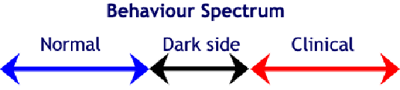
So people who are normally Enthusiastic, when under pressure can become Volatile, see the following table for the full list. Interestingly, if you think about some of the comments you might get from your colleagues or loved ones, and you will often see these are referring to your 'dark side' behaviours. You might even realise that under pressure you just close your door (either literally or figuratively), put your head down and start plodding on.
| Positive | Negative | Description of Dark side |
|---|---|---|
| Enthusiastic | Volatile | Moody and hard to please, being enthusiastic about new people or projects and then becoming disappointed with them. |
| Shrewd | Mistrustful | Cynical, mistrustful, and doubting the true intentions of others. |
| Careful | Cautious | Concerns seeming reluctant to change and being too concerned about making mistakes. |
| Independent | Detached | Aloof or uncommunicative and lacking interest in or awareness of the feelings of others. |
| Focused | Passive(covertly) Aggressive | Independent, refusing to be hurried, ignoring other people's requests, and becoming irritable if they persist. |
| Confident | Arrogant | Unusually self-confident, having strong feelings of entitlement, being unwilling to admit mistakes, listen to advice, or attend to feedback. |
| Charming | Manipulative | Enjoys taking risks and testing the limits, easily bored, and seeking excitement. |
| Vivacious | Dramatic | Lively, expressive, dramatic, and wanting to be noticed. |
| Imaginative | Eccentric | Acts and thinks in unusual and sometimes creative ways. |
| Diligent | Perfectionist | Meticulous, precise, and critical of the performance of others. |
| Dutiful | Dependent | Eager to please and reluctant to take independent action |
The thing is, if these behaviours are coming from the person at the top, then they can be disastrous (read "Why CEOs fail for 11 case studies of big corporations such as Enron and Xerox brought down by this kind of behaviour.)
"We all need to look into the dark side of our nature - that's where the energy is, the passion. People are afraid of that because it holds pieces of us we're busy denying." Sue Grafton
The truth is every one of us can 'lose the plot' a bit when we are under pressure and the very things which normally help us, taken to excess, can shot us in the foot. Realising this enables us to help others and gain help for ourselves. Ask people who know you and whom you trust "What 3 things do I tend to do when under pressure?" and you will almost certainly find that they relate to this list. Having established your personal 'red flags', then you need to get them to help you once they see them, even it is only saying "Freddy, you have shut that door again!" Once you realise that behaving badly isn't the same as 'being bad' it is easier to accept help.
We all get stressed, and we all need a little help from our friends when we are in that place. Learning how to accept it may just be one of the most valuable lessons of your career. Recognising the danger signs in your team, may also do a vast amount to improve performance and morale.
"Fear is the path to the dark side. Fear leads to anger. Anger leads to hate. Hate leads to suffering." Yoda
Testimonials:
Only one other organisation I know could have designed and facilitated this so well ... and they no longer exist - Senior Cap Gemini Consultant
click here for more testimonials

What's New?
Article: Management and Change Management
Blog: We've been Trumped... or Brexit pt II
There is a certain relief in change, even though it be from bad to worse! As I have often found in travelling in a stagecoach, that it is often a comfort to shift one's position, and be bruised in a new place. - Washington Irving